Lab 6: IoT Web Portal & SPI Temperature Sensor (DS1722)
Introduction
In this lab I built a small IoT device: an STM32L432KC microcontroller talks SPI to a DS1722 digital thermometer and UART to an ESP8266 that serves a minimal HTML page. The webpage lets a user toggle an LED, view the temperature, and select the sensor resolution (8–12 bits). I wrote a CMSIS-only SPI driver, verified the serial links with a logic analyzer, and debugged the DS1722 configuration so higher-resolution modes update correctly.
System Overview
Data path. DS1722 →(SPI)→ MCU →(UART)→ ESP8266 →(Wi-Fi AP)→ browser. Control path. Browser requests /ledon, /ledoff, or /res{8..12} → ESP forwards /REQ:... to MCU → MCU toggles LED and/or updates DS1722 configuration → MCU renders fresh HTML → ESP serves it.
General Schematic. 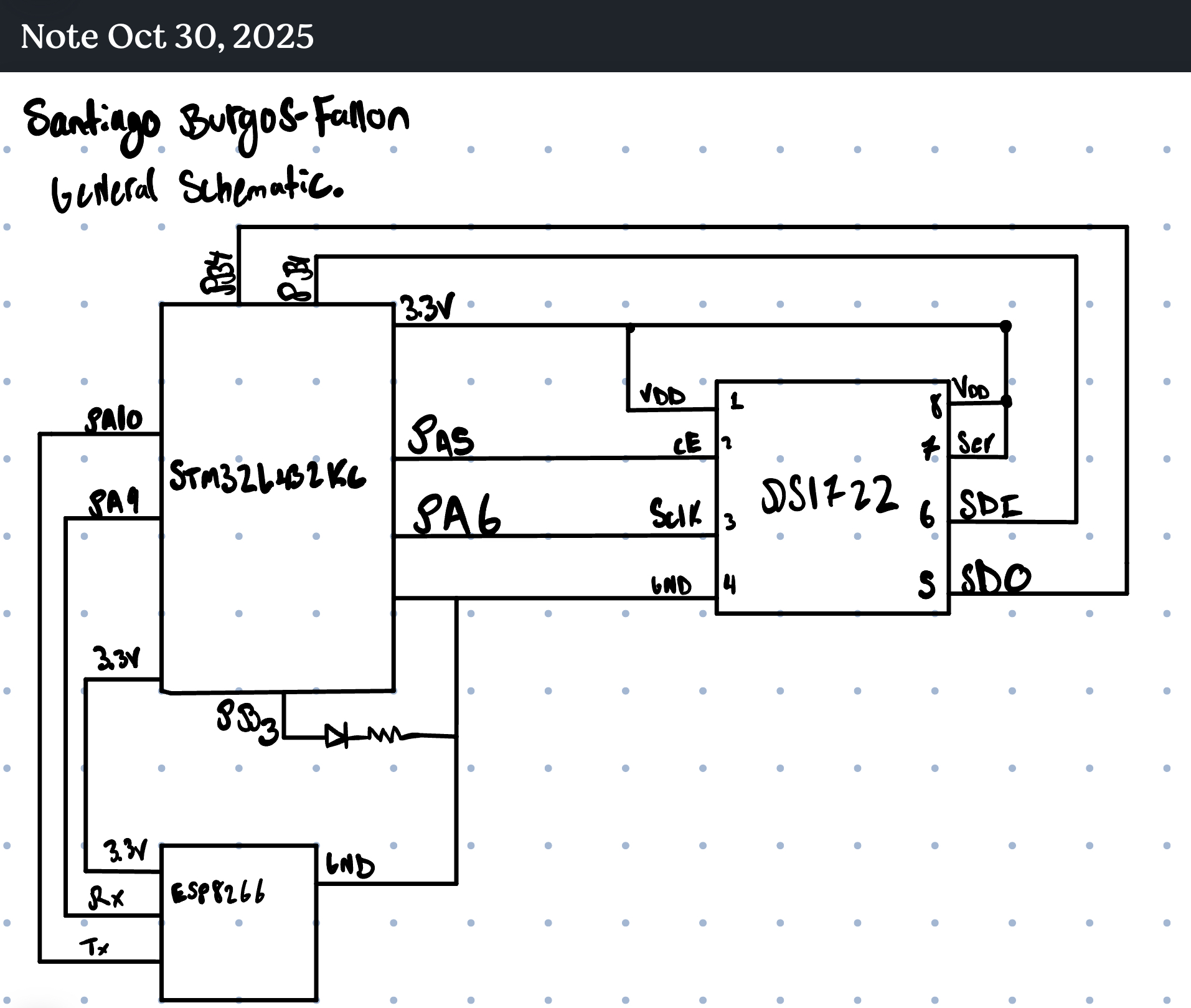
DS1722 Essentials (what finally made it work)
- Config register layout: I map R2:R1:R0 to bits 3:2:1 and keep SD=0 for continuous conversions.
- I/O addresses: read
0x00, write0x80. - Data format: left-justified 12-bit signed; 1 LSB = 1/256 °C:
- Expected CONFIG hex (sanity checks): 8-bit →
0xE0, 9-bit →0xE2, 10-bit →0xE4, 11-bit →0xE6, 12-bit →0xE8. - Conversion time increases with resolution (≈75 ms @8-bit up to ≈1.2 s @12-bit). The registers hold the last completed value until the new conversion finishes; that’s why higher resolutions appear “slower.”
SPI Driver (CMSIS)
- Initializes SPI1 with chosen prescaler, CPHA=1, software-managed NSS.
- Manual CE is asserted HIGH before sending the address and stays high through the data byte(s).
- Blocking 8-bit transfers via
DRwithTXE/RXNEpolling.
ESP8266 Request Protocol
ESP sends a single line like:
/REQ:ledon\n
/REQ:          (for root /)
/REQ:res12
MCU parses the token, updates LED or DS1722 config, then returns a complete HTML page. The ESP forwards it to the browser once it sees
</html>(or after a 200 ms idle gap).
Web Page / UI
- Controls: LED On/Off buttons; resolution buttons (8/9/10/11/12-bit).
- Telemetry: current temperature in °C and °F; current CONFIG byte (for debug).
- Minimal CSS for legibility.
HTML Generation Notes
- The MCU emits the HTTP header and then a single HTML document (no AJAX).
- Each button click triggers a fresh page render (stateless).
- On a resolution change, the page reads CONFIG back and displays it so I can confirm the write took effect.
Logic Analyzer Capture

What to see:
- CONFIG write: CE goes HIGH, MOSI sends
0x80(write), then the data byte (e.g.,0xE8for 12-bit). SCK edges align with CPHA=1. - Temperature read: CE HIGH, MOSI
0x01(LSB addr) then one dummy byte; MISO shows LSB. Repeat for MSB (0x02). - Idles return MISO high
Results
- LED control from the webpage works reliably.
- Temperature displays in °C and °F, updates on each refresh.
- Resolution switching 8→12 bits works; CONFIG shows the expected hex.
- At higher resolutions the value updates more slowly (by design); the last reading is held until the new conversion completes—consistent with the datasheet.
Time Spent
~14 hours
Known Limitations / Future Work
- No auto-refresh; a timed meta-refresh or small JS would update values without clicks.
- Could add an on-page indicator for “conversion in progress” at higher resolutions.
- Burst read (MSB+LSB under one CE) would reduce overhead slightly.
AI Prototype
Prompt 1 (UI):
I’m making a web portal to interface with a temperature sensor. Create an HTML page that looks good and is intuitive to show the temperature, control an LED, and change the precision of the readout.
What happened. The LLM produced a clean, semantic HTML/CSS snippet with buttons for LED on/off and resolution (8–12). It assumed typical REST paths (/ledon, /res12) which matched the lab’s /REQ:... pass-through, so I only had to paste the <body> into my MCU string generation. Styling was lightweight and rendered fine on mobile. Takeaway: For front-end scaffolding, the LLM sped things up and required minimal edits.
Prompt 2 (SPI function):
Write me a C function to carry out a SPI transaction to retrieve a temperature reading from a DS1722 sensor. Make use of CMSIS libraries for the STM32L432KC.
What happened. The first draft mixed HAL calls and got CPHA wrong, and it didn’t keep CE asserted across address+data. It also read only one byte (dropping either MSB or LSB). After I corrected to CMSIS-only, enforced CPHA=1, kept CE high, and read both bytes, the code worked. The LLM was useful as a skeleton, but device-specific details (register map, timing, bit fields) needed careful verification against the datasheet and on the logic analyzer.
Overall: LLMs handled UI boilerplate very well. For low-level peripheral code, they were helpful to outline structure, but hardware-exact details still required my domain knowledge and lab instrumentation to validate and fix.